Description
Brett J Skinner | CHPI | DEC 2025
– ABSTRACT –
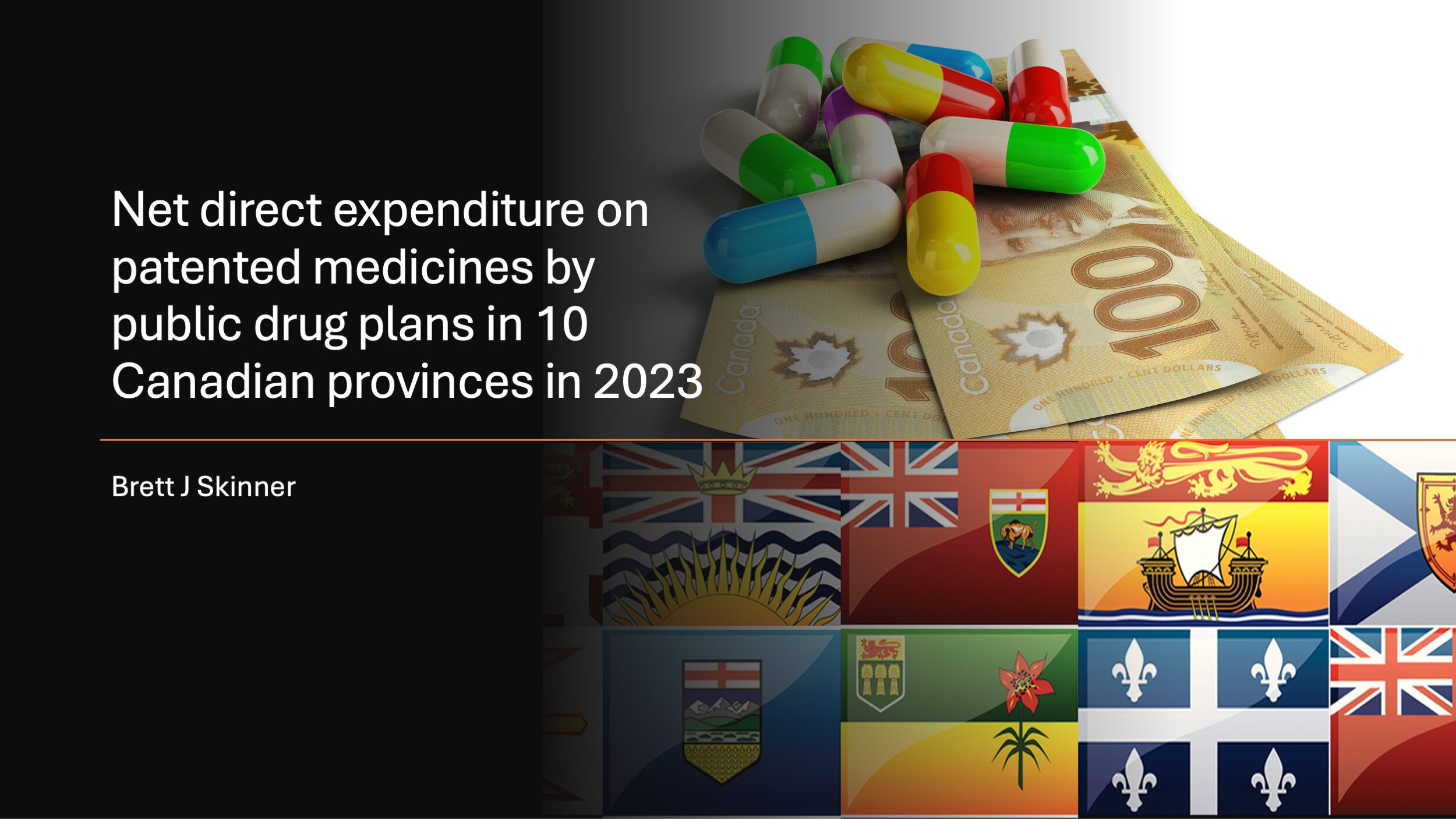
Canada’s federal, provincial, and territorial governments argue that price controls are necessary, because the cost of patented drugs is too high and threatens the fiscal sustainability of public healthcare systems. Previous research using data from the PMPRB showed that net of manufacturers rebates, at the national level, total public (including federal, provincial and territorial drug plans, hospitals, worker safety insurance boards, etc.) expenditure on patented medicines accounted for only 2.1 percent of total public healthcare expenditure in 2022 (CHPI 2024). The PMPRB does not publish patented drug sales by province. Alternate data were obtained from the PMPRB’s annual public drug plan spending report for the fiscal year 2022/23 (PMPRB 2025) which allowed for the isolation of provincial–specific spending on prescribed drugs with separately reported costs related to pharmacy dispensing fees, beneficiary-paid copayments and deductibles by province, and the province–wide average portion of total prescription expenditures attributable to patented drugs. Due to commercial confidentialities, data on manufacturer rebates were not publicly available. However, an estimate of the average rebates applied to Ontario’s public drug plans was available and was extrapolated across the provinces. Ontario data on wholesale and retail price mark ups were also available. Together these data allowed for an estimate of provincial public drug plan spending on patented medicines that is comparable to the national sales data published by PMPRB while accounting for manufacturers rebates. Across all 10 provinces, the average net direct expenditure by public drug plans on patented drugs was $68 per capita. Stated as a percentage of total public healthcare expenditure per capita, the net direct expenditure per capita by public drug plans on patented drugs averaged 1.0 percent. Ontario had the highest expenditure on patented drugs and the lowest overall public healthcare costs. The result is consistent with the economics literature. Research suggests that interprovincial differences in access to, and utilization of newer medicines are associated with meaningful differences in population health outcomes. Previous research (Skinner 2025) on the number of new patented drugs covered in provincial public drug plans shows a correlation with the spending data from the present study. The greater availability of new drugs in Ontario is associated with lower overall healthcare utilization reflected by lower public healthcare expenditure. Potentially avoidable public healthcare costs associated with provinces that spent less than Ontario’s public drug plans on patented drugs were estimated to total $21.3 billion in 2023. For comparison, the cost of closing the gap with Ontario on net direct spending per capita for patented medicines totalled $918 million across nine provinces.
Author’s credentials and affiliations: Brett J Skinner, PhD, is the founder and CEO of CHPI and the editor of Canadian Health Policy journal.
Citation: Skinner, B. J. (2025). Net direct expenditure on patented medicines by public drug plans in 10 Canadian provinces in 2023. Canadian Health Policy, DEC 2025. www.canadianhealthpolicy.com.